An operating facility, in context.
An industrial facility needs more than a geometric model or an isolated sensor trend. A useful workflow connects existing-condition surveys to the right assets, separates room conditions from process measurements and identifies which observations come from supplied instruments versus existing plant systems. Software then makes the records useful for engineering review and handover.
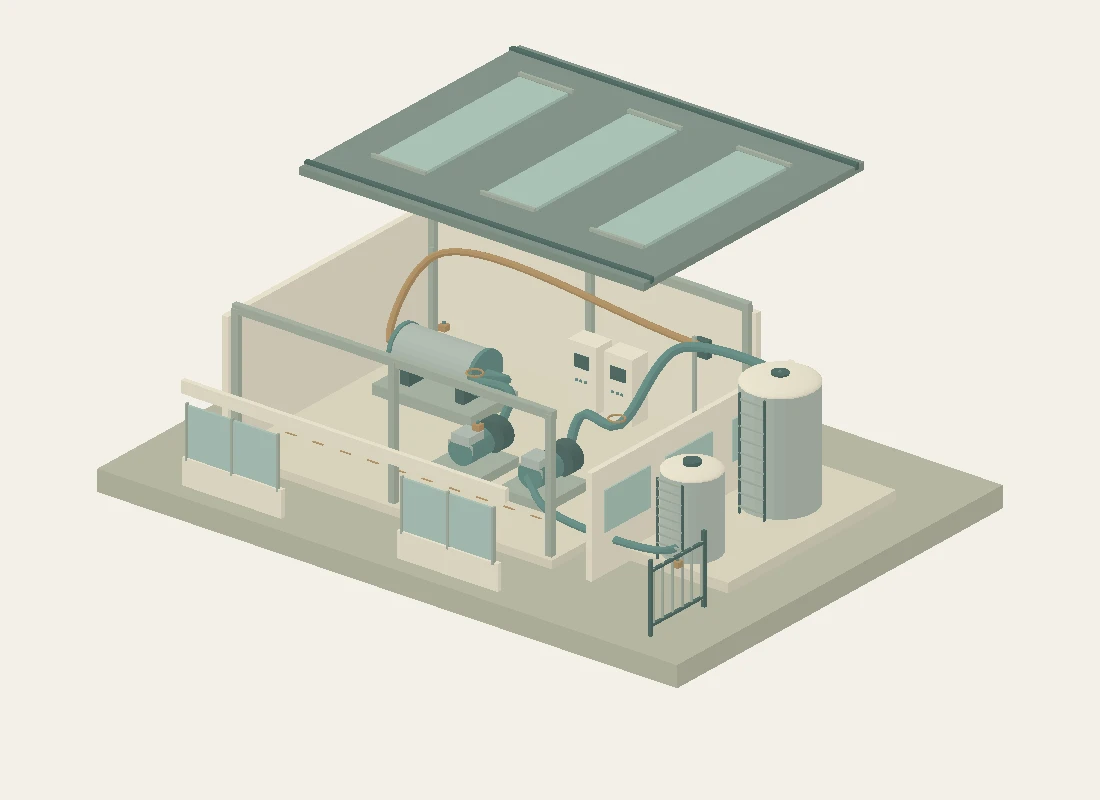
Explore the same site in the interactive experience.
Document existing conditions
Capture accessible buildings, equipment and pipework for as-built drawings, models or retrofit coordination. Agree the required detail and verification scope. A sectional model helps a viewer look inside; it is not evidence that inaccessible surfaces were measured.
Define the sensing chain around each asset
Keep workshop temperature and humidity separate from a heat-exchanger outlet temperature. Utility-water level and conductivity require their own references, probe suitability and calibration arrangements. Machinery vibration and gate events may be imported from existing monitoring or control systems through scoped interfaces.
Connect readings to service history
Link the observation to an asset identifier, location, time basis and illustrative service record. A report should distinguish a measurement, an inspection note and a diagnostic conclusion. An overall vibration trend may justify further investigation; it does not identify a fault by itself.
Inputs to agree
- Survey areas, access limitations and retrofit or documentation objectives
- Asset identifiers and available drawings or equipment records
- Measurement locations, process conditions and compatible acquisition
- Existing plant interfaces, permissions and maintenance/review responsibilities
Possible outputs
- As-built drawings, coordinated models or point-cloud review outputs
- Utility-water and indoor-environment histories
- Scoped equipment and gate-event integration
- Asset-linked observations, review notes and engineering reports
Keep the measurements distinct
| Quantity | Unit or component | Interpretation |
|---|---|---|
| Process vs room temperature | Both may use °C | Different locations, instruments and decisions. |
| Tank level span | % of configured height range | Not necessarily percentage of tank volume. |
| Conductivity | µS/cm at a stated reference temperature | Not a complete water-quality or safety test. |
| RMS vibration velocity | mm/s with a stated band and window | An overall observation, not a component fault diagnosis. |
Does 80% tank level mean the tank contains 80% of its volume?
Not necessarily. A level percentage can represent the configured empty-to-full height span. Converting level to volume requires the tank geometry or a calibrated capacity table, particularly for non-uniform tank shapes.
Can conductivity establish whether water is safe?
No. Conductivity reflects electrical behaviour related to dissolved ions and temperature; it is not a complete water-quality or safety test. State the reference temperature and use the relevant probes, calibration and additional analyses for the actual purpose.
Technical references
Further reading on the measurement principles discussed above.
Content reviewed · Skyrover