A building, through its working day.
An office-complex workflow combines a surveyed building baseline with indoor conditions, energy observations and carefully defined space-use records. CO₂, temperature, humidity and light describe different aspects of a room. Rooftop irradiance, module temperature, inverter power and building load describe different parts of the energy chain. Software helps users explore those boundaries without hiding them.
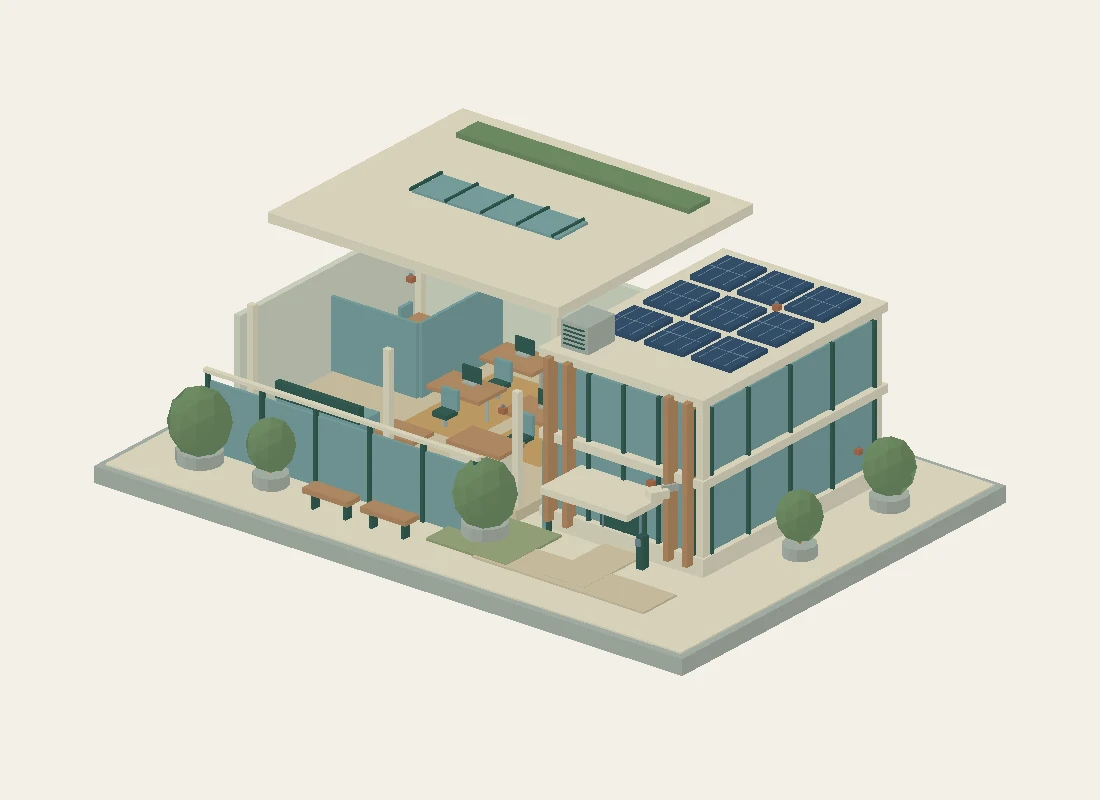
Explore the same site in the interactive experience.
Establish a building baseline
Document accessible rooms, campus geometry and existing services for refurbishment, coordination or facilities review. Define survey control, coverage and model detail. The cutaway in the interactive illustration is a viewing aid, not a claim about how all interior geometry was captured.
Separate environment, energy and use
Choose suitable logger locations and measurement intervals. Indoor CO₂ is not complete air quality. Array-plane irradiance is not electrical power; module-backsheet temperature is not room temperature. Presence duration and access-reader events are not interchangeable with unique-person counts.
Review a consistent energy boundary
Align PV AC power with gross building load before deriving grid exchange. Compare like intervals and preserve quality notes. Actual energy reporting requires accumulation over a stated period; point-in-time power values cannot be relabelled as daily energy or an annual savings estimate.
Inputs to agree
- Building extent, room/asset identifiers and required model detail
- Sensor placement, time basis and calibration/maintenance arrangements
- Meter and inverter boundaries, available interfaces and permissions
- Agreed space-use definitions and data-handling requirements
Possible outputs
- Building survey and scan-to-BIM or spatial-review deliverables
- Indoor condition and room-context views
- Aligned PV and gross-load observations with a defined derived boundary
- Reports with sources, timestamps, units and quality context
Keep the measurements distinct
| Quantity | Unit or component | Interpretation |
|---|---|---|
| Electrical power | kW | A snapshot or a defined averaging interval. |
| Electrical energy | kWh | Power accumulated over a defined period. |
| Solar irradiance | W/m² | Radiant power per area on the specified plane. |
| Occupied time | % of an interval | Presence duration; not a count of unique people. |
Is CO₂ a complete indoor-air-quality measure?
No. CO₂ can help interpret occupancy-related ventilation demand in context, but it does not measure all pollutants or establish overall indoor-air quality. Placement, outdoor conditions, occupancy and the relevant ventilation assessment matter.
What is the difference between kW, kWh and W/m²?
kW measures electrical power at a point or over a stated averaging interval. kWh measures energy accumulated over time. W/m² measures irradiance incident on a defined plane. A solar-performance workflow must keep those quantities and their time/measurement boundaries distinct.
Technical references
Further reading on the measurement principles discussed above.
Content reviewed · Skyrover